Here an update on the reaction of the City of Stirling Council to the WA State Government’s proposed redevelopment of the 18.75 hectare site at Mt Lawley, being the former campus of Edith Cowan University (ECU).
In 1970 the site started as a teachers’ college and a campus for the Western Australian College of Advanced Education. In 1991 the site became part of ECU when it was officially granted university status. ECU’s predecessor institutions are many, dating from the Claremont Teachers College in 1902, and include the current Western Australian Academy of Performing Arts (WAAPA) which was established in 1980. In February 2026 ECU, including WAAPA, relocated from Mt Lawley to a new modern campus for over 10,000 students and staff in the Perth CBD.
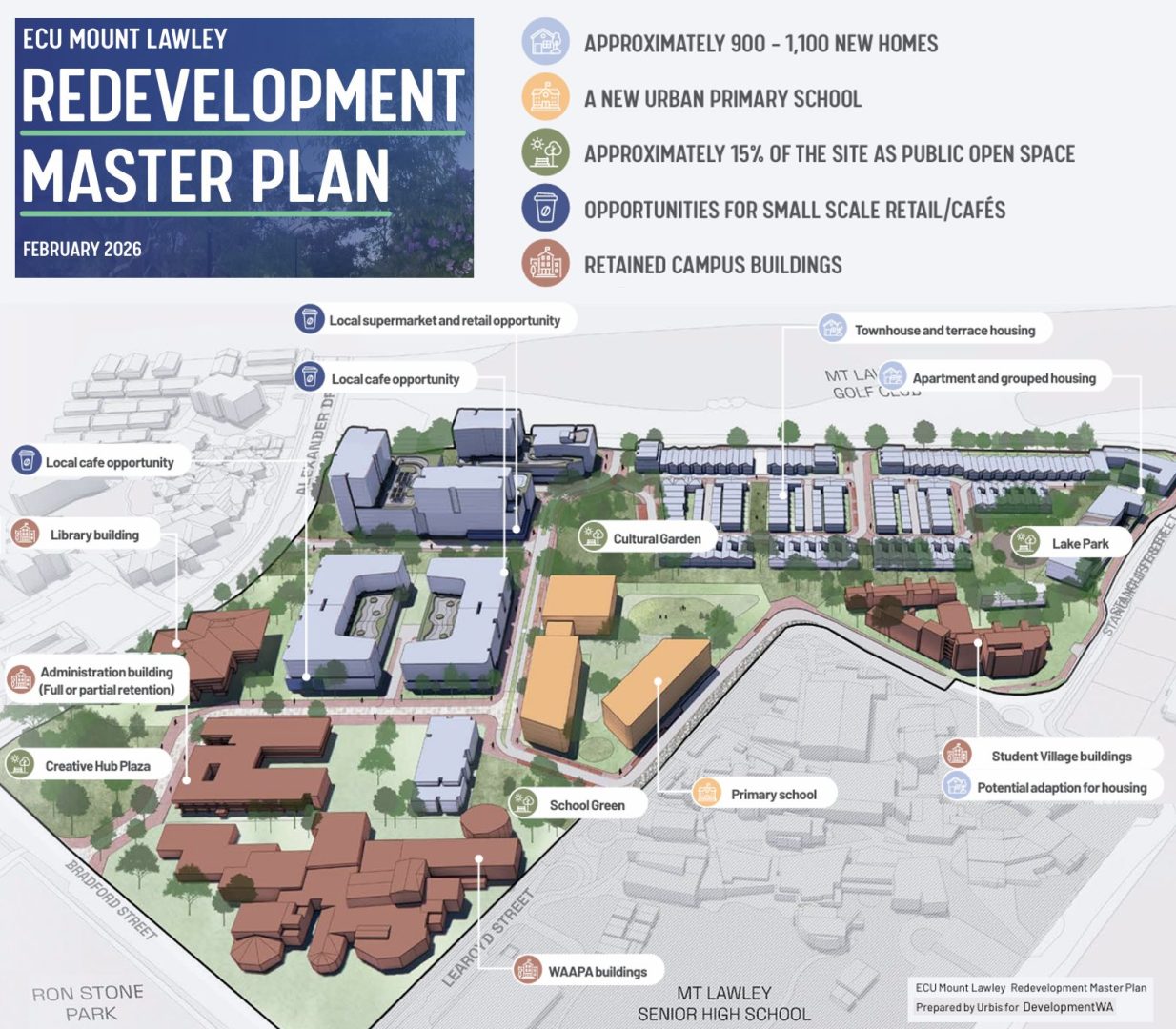
The WA State Government’s Redevelopment Master Plan for the site at Mt Lawley, proposes to transform the location into an urban village, with up to 1,100 new dwellings (a mix of apartments and townhouses), a new primary school, a Creative Industries Hub repurposing the Library, WAAPA and Administrative buildings for arts and cultural uses, community and retail spaces including a supermarket, and 15% green public open space with green corridors.
On 7th July 2026, after a long debate, the City of Stirling Council voted 11/1 not to approve the ECU Mount Lawley Redevelopment Precinct Structure Plan of DevelopmentWA (the Western Australian Government’s central land and development agency), due to issues with traffic, tree canopy, and the impact on the surrounding Community. Concerns were cited over high-density designs, the “concrete jungle” feel of the initial 1,100 home housing proposal, and the potential removal of up to 840 trees and impact on bird habitat.
Councillor Suzanne Migdale said community feedback was that residents did not support the proposal in its current form. She said “Residents are worried about the building heights and density that they see as being out of scale for a suburb that is not an activity centre”. She said the proposal had failed fundamental planning principles. “A structure plan that concentrates our largest built form, traffic and parking risks into a single non-centre suburb with no hard height limits in space and unresolved school parking and safety issues doesn’t meet that test”.
Councillor Elizabeth Re said the redevelopment risked destroying decades of environmental work on the site. She said “The trees that were planted have encouraged wildlife and biodiversity in the neighbourhood, they shouldn’t be trashed in such a way that is suggested to make it another concrete jungle”. She said that the former campus held important educational and historical significance. “This is a great opportunity to ensure that the history, the heritage of the people, groups, etc within the City of Stirling are maintained.” She said the proposal needed better balance. “Nobody is saying let’s not do any houses; we all know we need houses” “What we’re saying is it needs a better matrix.”
The Council rejection means the exact scale, dwelling count, and development layouts will undergo further revision and consultation between the state and local governments before moving forward.
MTLAE_2026-01-13_ECU_Redevelopment_Final_Master_Plan_Report_LR.pdf